Sales is the part of senior living work I have spent the most of my career doing. I started as an administrator-in-training in my early twenties, took over my own community not long after, and repositioned that community from a high-acuity Medicaid facility into a thriving Medicare and private-pay operation, in significant part by rebuilding how we sold it. Three decades later, having consulted with more than eighty communities across twenty-eight states, I still see the same pattern most weeks. Sales performance stalls, and the instinct is to do more.
More outreach. More tours. More follow-up. More marketing spend.
More is almost never the answer. Better is.
What Senior Living Sales Actually Is
Senior living sales is not transactional. It is the disciplined work of building trust with a family in the middle of one of the hardest decisions they will ever make. That is different from selling almost anything else, and it demands a different discipline.
Most communities I’ve assessed have enough inquiries. They are running enough tours. They are following up, though usually not as personally or as strategically as they should. What is broken is rarely at the top of the funnel. It is the quality of the conversations happening in the middle, and the discipline of the system that moves a family from an initial phone call to a move-in over what is often a twelve to eighteen month journey.
The industry has a benchmark for this that I anchor on when I train sales teams. ProMatura research from studies of more than ten thousand prospects has established that it takes on average twenty-five hours of direct selling time to make an independent living sale, and fourteen hours to make an assisted living sale. Not twenty-five hours of activity. Twenty-five hours of direct, one-on-one, prospect-centered engagement. That is the shape of good work.
Sales teams that produce consistent results are not necessarily the ones working the hardest. They are the ones spending more hours with fewer prospects.
The One Thing That Usually Breaks
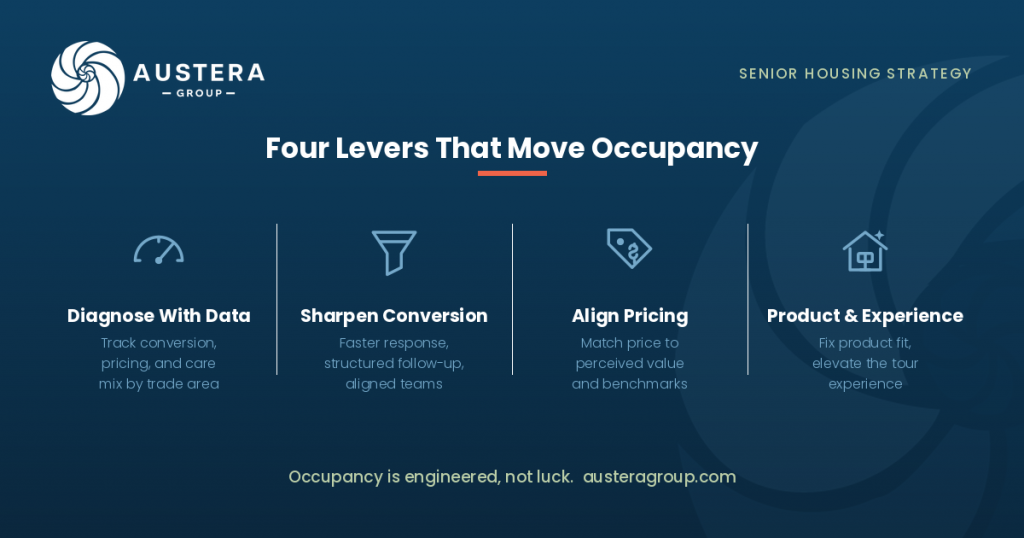
When a community’s conversion is soft, the answer is almost always sitting in one of five places. In our practice, we walk teams through this diagnostic before recommending any change.
- Discovery is thin. Sales counselors are asking surface-level questions and moving too quickly to the tour, missing the deeper information that would make the tour meaningful.
- Response time is broken. Prospects are calling and getting automated voice menus, being misrouted, or waiting more than twenty-four hours for a callback. In an emotionally driven decision, that lag is fatal.
- Follow-up is not personalized. Communities send the same nurture sequence to every prospect regardless of what they said, what they cared about, or where they are in their decision journey.
- The tour is not customized. Prospects walk through a standardized route that could have been walked by anyone, when they should be experiencing something tailored specifically to who they are.
- CRM discipline is inconsistent. Notes are thin, follow-up cadence is not tracked, and the sales director cannot see the pipeline clearly enough to coach the team on where the real bottlenecks sit.
The single most useful thing a sales team can do is stop trying to fix all five at once. Pick the one that is doing the most damage, focus on it for the next quarter, and rebuild discipline around it. You have to slow down to go fast.
Discovery Is the Differentiator
If I had to point to the single skill that separates strong senior living sales teams from average ones, it is the depth and quality of discovery, and specifically how much of that discovery happens before the tour rather than during it.
Most communities do not take the time to learn as much as possible about the prospect and family before the tour, and it shows in the tour itself. The goal becomes getting the tour rather than making the tour memorable. That is backwards. The tour should be the payoff for the discovery, not the beginning of it.
A sales counselor who has done good discovery on a phone call knows what programs, meals, and residents to have ready when the prospect arrives. If the prospect mentioned they love live music, invite them for the tour during a musical program you know they will enjoy. Have the community calendar in front of you when you are on the phone, so you can suggest something specific. If they are coming for a meal, make sure it is something they actually like, and think about which residents with similar backgrounds might join them. Details like this are what turn tours into memorable experiences, and memorable experiences are what convert.
There is also good data supporting this. Prospects who move through a longer, trust-built sales cycle stay significantly longer as residents. Rushed, transactional sales cycles correlate to shorter lengths of stay and higher move-out rates. Time invested in discovery pays back not just in a stronger tour, but in a stickier resident.
Response Time and Lead Management
The lag between when a family reaches out and when they hear back from a real person is one of the single most correctable problems in senior living sales, and it is also one of the most common. In a recent mystery shop we conducted for a large rental CCRC, the caller expressed interest in independent living, was greeted by an automated voice menu, transferred to a receptionist, transferred to the voicemail of the Director of Admissions for assisted living, and eventually received a callback from the sales director about twenty-four hours later.
Every step of that flow is broken. The voice menu asks a family in the middle of a stressful moment to make an unclear choice. The routing sends them to the wrong care level. The callback comes long after the emotional moment that prompted the call has passed. Families do not stay in that emotional window for very long. They call, they get pointed to another community, and by the time the callback comes, they are already in someone else’s tour.
Fixing this is not expensive. It requires a live person answering the phone during business hours, a defined routing protocol that puts a prospect in front of the right salesperson within minutes, and an after-hours plan that responds meaningfully rather than just capturing a voicemail.
Language and Titles Matter More Than You Think
This is a piece most operators underestimate, and one I have been talking about for years. The words a community uses in its titles, its marketing, and its sales conversations shape how prospects and families feel about the place before they ever walk in.
Titles like Director of Admissions are clinical. They belong in skilled nursing settings, not in a majority independent living community. The hospitality equivalents are Director of Community Relations, Retirement Counselor, or Sales Counselor. Words like admissions and discharges belong in a medical setting. In private pay senior living, we talk about move-ins and move-outs. Departments are dining rather than dietary, resident services rather than activities, wellness rather than nursing. Small words, big impact. The language sets the tone. The tone sets the resident and prospect experience. Sales teams operating from clinical vocabulary sound clinical, and prospects hear it even if they cannot name what they are reacting to.
The Person-Centered Frame
Something I believe deeply, and something I do not think our industry talks about enough, is that senior living sales is a person-centered craft, not a metrics exercise. Every prospect on your CRM dashboard represents a family in transition. Siblings are often working through their own conflicts about the decision. The sibling who ends up bearing the responsibility feels alone. The prospect themself may be grieving something they aren’t ready to name yet.
Sales teams that understand that reality and organize their process around lessening stress and over-communicating throughout the journey convert at meaningfully higher rates than teams that treat prospects like leads to be moved through a pipeline. It also produces a different kind of resident. Families who felt cared for during the sales process become the community’s strongest advocates once they move in. That is how occupancy actually compounds over time.
Marketing and Sales as One System
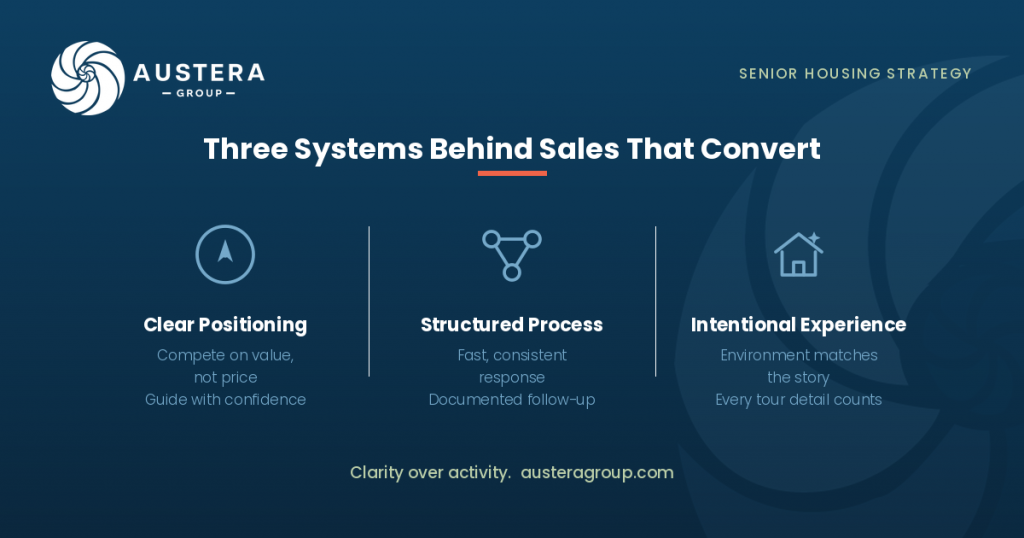
Marketing and sales cannot be run as separate functions. When they are, the seams are visible to the prospect. The messaging in the digital ad promises one experience, the sales conversation delivers another, and the tour delivers a third. Trust erodes at each step.
Sales needs to know what marketing is promising in every campaign. Marketing needs to know what sales is hearing in discovery, so the messaging can evolve. Both need to share the same KPIs and hold each other accountable to conversion, not just to volume. When those two teams operate as one system, lead quality improves and conversion becomes more predictable.
When to Bring in Outside Help
Sales performance issues are among the most common reasons ownership brings us in. Sometimes it is because occupancy has stalled and the team is too close to the problem to see the one thing that would move it. Sometimes it is because a new sales director has just come in and needs a diagnostic before rebuilding. Sometimes it is because a leadership transition has left the sales culture unclear, and the team is executing without a shared playbook.
In each case, the value of outside perspective is that we can see the sales system clearly, identify the one thing that will move performance most, and equip the team to execute against it. Bringing in outside eyes is not a signal the internal team has failed. It is a commitment to the outcome.
Where to Go From Here
Sales strategy in senior living is not about scripts or activity. It is about building the disciplined systems and person-centered practices that let a team have consistently deeper conversations with fewer prospects, and turn those conversations into families choosing to move in.
If your community’s sales performance is stalled, the answer is almost never more. It is usually deeper.
Ready to Talk?
If your community’s sales performance is inconsistent, your conversion is stalled, or you are trying to figure out where to focus your team’s energy first, we can help. Book a discovery conversation with our team and we’ll walk through what you’re seeing.