Whenever someone asks me what I do, my answer is that Austera Group is a positioning advisory group for senior living. Nine times out of ten, the follow-up question is: “What is that?”
Fair. The industry uses the word consulting to describe everything from marketing agencies to interim management to real estate advisors to construction management. If it feels like the term has lost meaning, that’s because in a lot of contexts it has. So let me give you the working definition I actually use with owners and operators.
The Real Definition
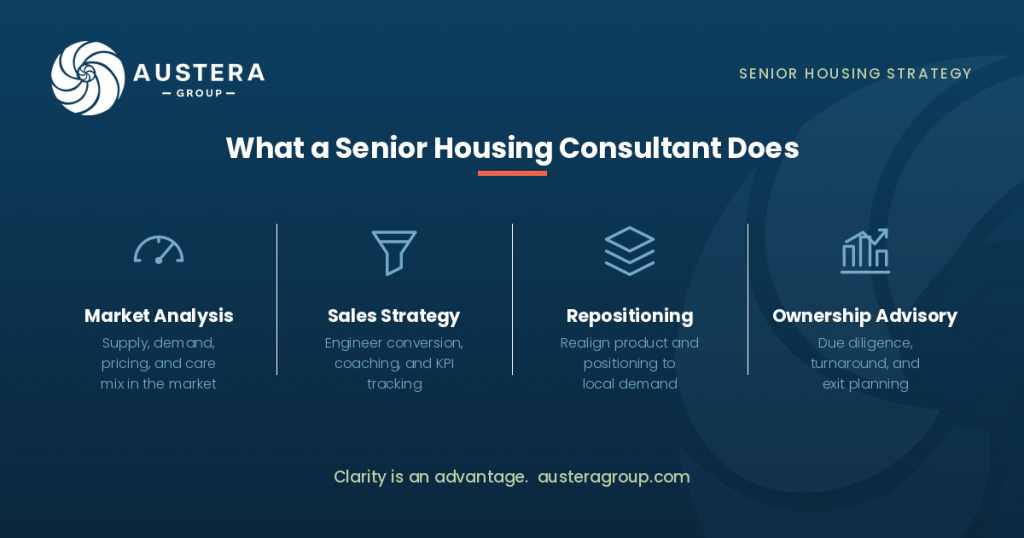
Senior housing consulting, done well, is strategic advisory support that helps ownership answer three questions honestly. Where does this asset actually sit in its market? What is standing in the way of it performing at its potential? And what are the two or three moves that will meaningfully shift performance in the next six to twelve months?
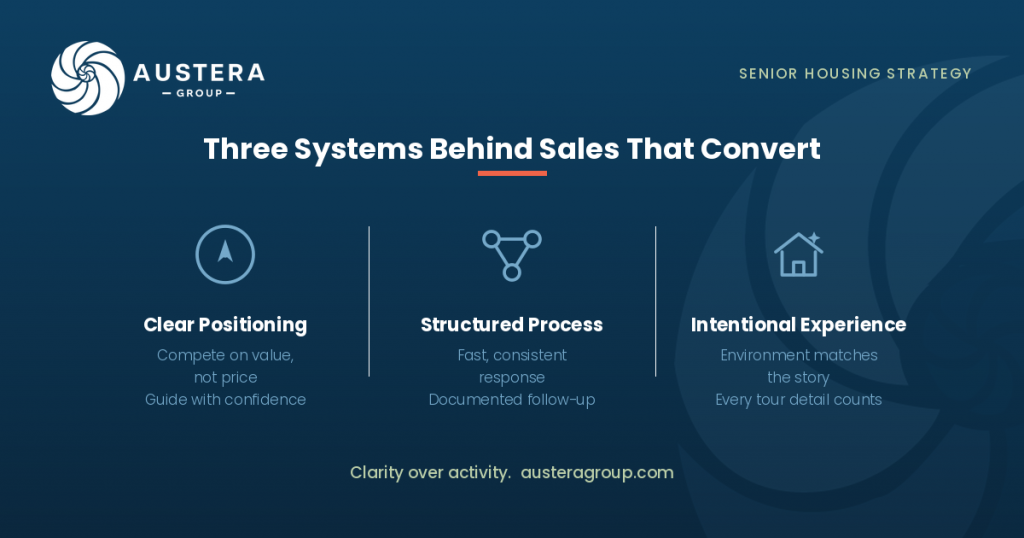
The word I anchor around is positioning. Nearly every occupancy problem, pricing problem, marketing problem, and even most operations problems I’ve been asked to solve in thirty years of senior living work track back to a positioning issue. The community is priced for one experience and delivers another. The care levels don’t match local demand. The sales team is trained for a different market cycle. The physical environment tells a different story than the marketing does. Consulting is the disciplined work of finding where the alignment has broken and helping ownership put it back together.
What Consulting Should Do, and Often Doesn't
The thing that frustrates me about how a lot of consulting engagements are scoped is that they’re built to expand rather than to help. The consultant walks in, produces a big report, identifies a long list of things wrong, and quietly angles for the next phase and the phase after that. Ownership gets a lot of paper. The community’s performance often doesn’t change much.
What good consulting should do is different. It should give ownership a clear read on what’s actually going on, focus attention on the one or two things that will move the needle most, and equip the team to execute against those things without needing the consultant on retainer forever. When we take on a new engagement at Austera Group, we are honest with the owner and the investor about what we see, and we’re deliberate about not creating dependency. At this stage of our careers, we are less interested in long-term scope creep than in helping the people and the buildings we work with actually get better.
Where Consulting Typically Fits
In our practice, most engagements start at one of five moments in the life of an asset.
- Before an acquisition, when ownership needs an objective read on the physical plant, the local market, the sales team, and the underwriting assumptions.
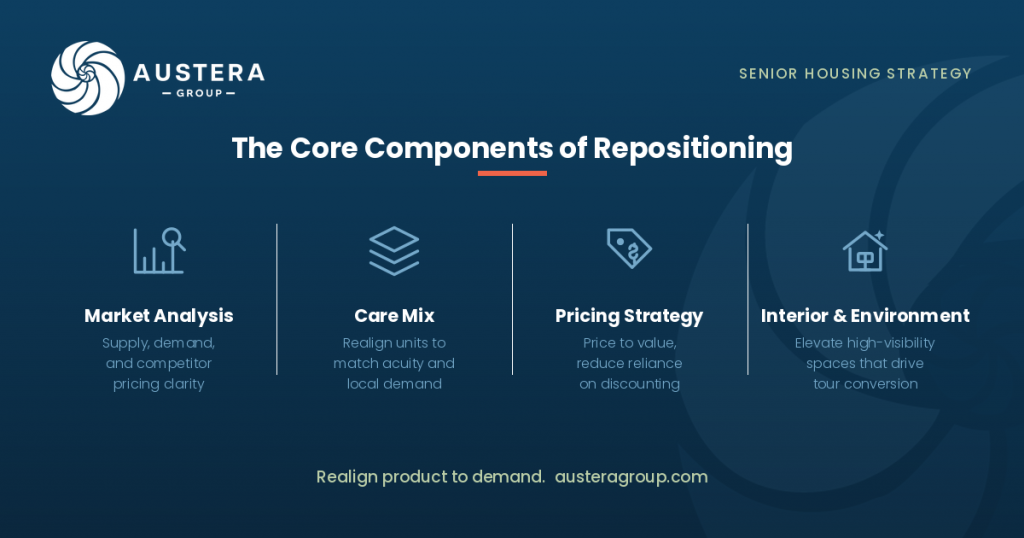
- During a repositioning or turnaround, when the community’s product has drifted from what the market actually needs.
- After leadership turnover, when a new operator or new sales director needs a diagnostic before rebuilding.
- In advance of a development or expansion, when the real question is what the highest and best use of the land or building actually is.
- When occupancy has stalled and the internal team is too close to the building to see the one thing that would move it.
What Separates Good Consulting From Average Consulting
A few things I look for, and things I hope owners look for, when evaluating whether a consulting engagement is going to be worth the investment.
Depth of lived experience. Senior housing is a specific industry with specific pressures. Consultants who have only worked from the outside tend to miss the operational realities that shape every strategic decision. Between my thirty years across operations, sales, and executive leadership, and my business partner Michelle Clark’s decades across interior design, development, and capital markets, we bring perspectives from both sides of every problem. We have been owners, investors, employees, managers, and C-suite. We understand what it feels like to be inside the building at 8 a.m. on a Monday, and we understand what ownership needs to see in the underwriting.
Honest scope. If a consultant is angling for the next phase before finishing the first one, that is a signal. Good consulting is built around what the client actually needs, not around what will maximize the consultant’s revenue.
Person-centered thinking. Something I believe deeply is that senior housing is a person-centered business, and consulting engagements that don’t hold that at the center produce cold recommendations that don’t stick. Every metric on a dashboard represents a family in the middle of a hard decision, a resident living out their day, and a team member trying to do good work. Good consulting keeps that reality in view.
Language and positioning literacy. In an assessment we completed last year for a large rental CCRC in the Midwest, one of the first things we called out was that the community was still using clinical language, admissions, discharges, activities, dietary, for a majority-independent-living community that should have been operating from a hospitality vocabulary. Small words, big impact. The language sets the tone. The tone sets the resident and prospect experience. Consultants who don’t notice that miss what actually moves the needle.
How We Scope Engagements
The single most useful piece of advice I give operators when we start working together applies to consulting engagements themselves. Pick the one thing that is broken, focus on it for six months, and stop trying to solve everything at the same time. Set two or three goals underneath that one focus, build tactics that connect to those goals, and hold the plan accountable through disciplined execution.
Consulting engagements that respect that principle produce results. Engagements that don’t tend to produce reports.
Interior Design as Part of the Consulting Conversation
One thing worth naming, because it is often treated as a separate discipline: interior design in senior housing is part of positioning, not decoration. The physical environment communicates the value proposition before a family sits down at the sales desk. When design aligns with the target market and the pricing, tours convert. When it doesn’t, no amount of marketing spend fixes the disconnect. That’s why our practice integrates design directly with the operational and sales work rather than treating it as a separate advisory silo.
When to Bring in a Consultant
The right time to bring in outside eyes is usually earlier than most operators think. Common inflection points include occupancy that has stalled or drifted downward, a market where new competition has meaningfully changed the landscape, an upcoming renovation or expansion, ownership transition, or the quiet realization that the internal team has been fighting the same problems long enough that they have stopped seeing them clearly.
The cost of waiting is often higher than the cost of the engagement. And bringing in a consultant is not a signal that the internal team has failed. It is a commitment to the outcome.
Where to Go From Here
Ready to Talk?
If you are weighing an acquisition, working through a repositioning, or trying to understand why occupancy isn’t where it should be, we can help you see the situation clearly and find the one thing that will move it most. Book a discovery conversation with our team.
Frequently Asked Questions
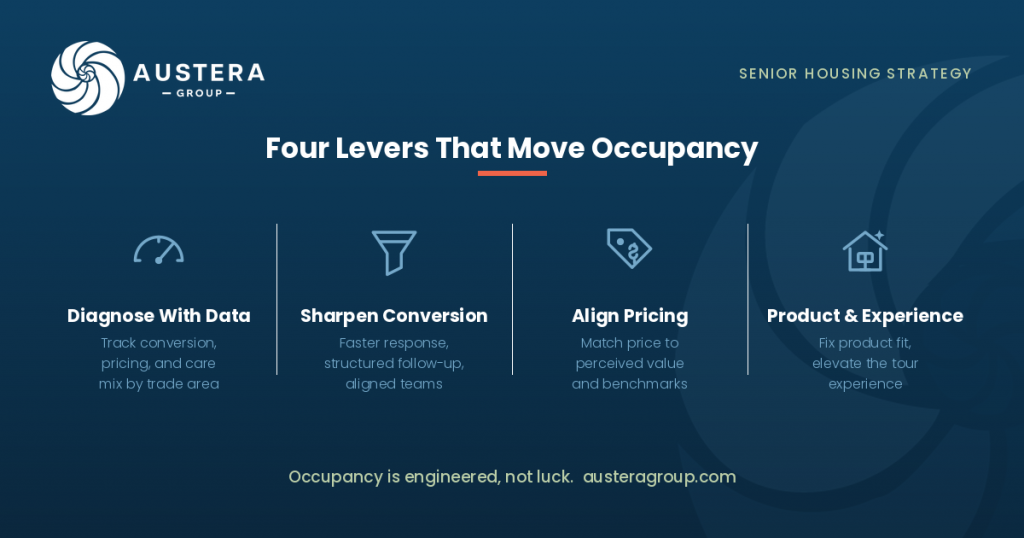
Yes, in almost every case. Occupancy problems usually track back to positioning, pricing, sales execution, or product fit. Consulting helps identify which of these is the real issue, and then focuses the team’s energy on solving it rather than trying to fix everything at once.