Over the last year, almost every occupancy conversation I’ve had with an operator or ownership team has started the same way. There’s a full list of what isn’t working. Marketing isn’t producing enough leads. Sales conversion is soft. Pricing feels off. The building could use a refresh. The market has more competition than it did two years ago. And underneath all of it, there’s a quiet worry that something bigger has shifted.
I’ve been in senior living for more than thirty years, and I can tell you the pattern doesn’t change much. When occupancy stalls, the instinct is to try to fix everything at once.
That instinct is what makes it worse.
The One Thing
The single most useful piece of advice I give operators when we start working together is this: pick the one thing that’s broken, focus on it for six months, and stop trying to solve everything at the same time. Set two or three goals underneath that one focus, build tactics that actually connect to those goals, and hold the plan accountable through disciplined execution. That is what improves occupancy in 2026. Not more marketing noise. Not another agency. A clear focus and the willingness to slow down long enough to go fast.
There’s a phrase I use often with my business partner and with clients: you have to slow down to go fast. Communities that skip diagnosis and jump straight to activity almost always end up doing more, spending more, and getting less. Communities that spend the time to understand where the real problem sits, and then organize their team around solving that one problem, consistently outperform.
Seeing the Community Clearly Before You Pick
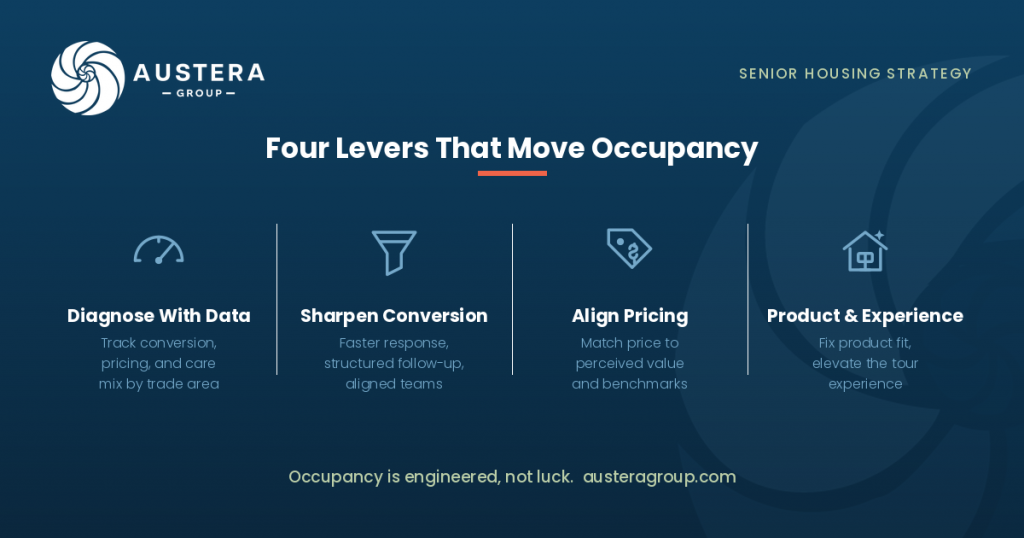
Before you can pick the one thing, you have to see the community clearly. That means looking at data honestly, not the way you want the story to read.
I’d start here:
- Is the local market actually soft, or is the community underperforming inside it? These are different problems with different solutions.
- What is the inquiry-to-tour conversion, and what is the tour-to-deposit conversion? These two numbers usually tell you whether the issue is at the top of the funnel or in the room during the tour.
- Is the pricing aligned with what prospects experience when they walk in, or is there a gap between what you’re asking for and what the environment communicates?
- Does the product actually fit local demand? A community serving the wrong care level for its market cannot marketing-and-sales its way out of a positioning problem.
- Is the sales team supported with the training, tools, and time they need to do the work well?
The pattern I see most often is that the answer to one of these questions is much louder than the others. That is your one thing.
Where the One Thing Usually Sits
In my experience, the one thing tends to live in one of four places.
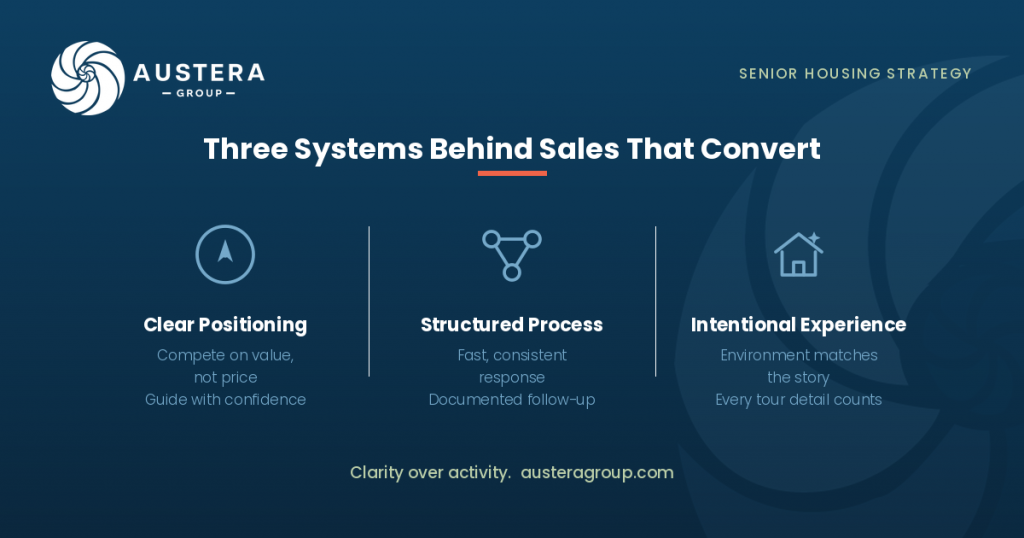
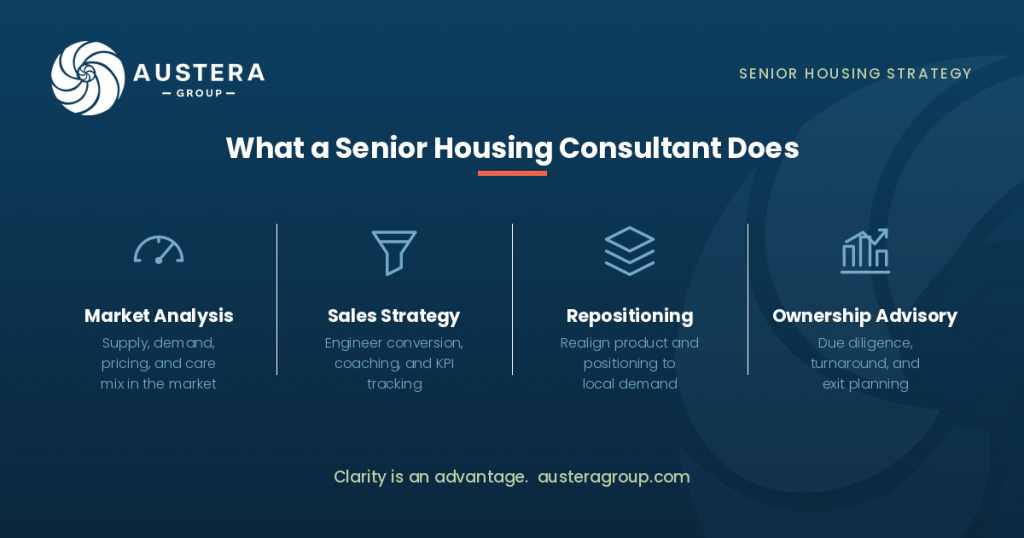
Sales execution. Most communities generate enough inquiries. What breaks down is what happens after the inquiry. Response time, discovery conversations, personalized follow-up, and the discipline to nurture leads over months instead of days. If sales is your one thing, the fix isn’t more inbound. It’s a better process, a better cadence, and a team that has been coached to lead with real curiosity about the prospect and family.
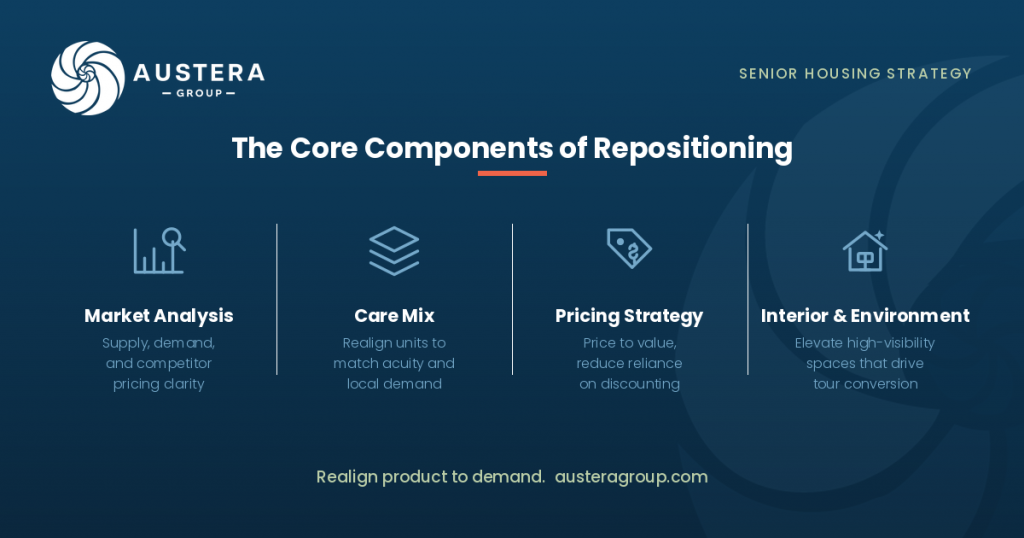
Pricing and positioning. Pricing isn’t a math problem, it’s a positioning statement. If a family walks in expecting one experience because of your rate and encounters something that doesn’t match, the tour is over before it starts, even if they smile politely on the way out. Pricing needs to align with what the community actually delivers, and repositioning is often necessary when the product has drifted from the market.
Product fit. Sometimes the community itself is out of alignment with local demand. Too much memory care in a market that needs more assisted living. Not enough higher-acuity capacity. Amenity spaces that don’t match how residents actually live today. This is where repositioning work becomes essential, and it’s almost always a two-year commitment before the results show up in the census. Anyone who tells you it is faster than that is selling something.
The tour experience. This is the piece most communities underestimate. The tour isn’t a script, it’s the moment where everything else you’ve built either lands or doesn’t. And most tours suffer because sales hasn’t taken the time before the tour to learn enough about the prospect and the family to actually customize the experience. If a prospective family enjoys live music, invite them for the tour during a program you know they’d love. If you’re inviting them for a meal, make sure it’s something they enjoy, and think about which residents with similar backgrounds might join them. Details like this are what turn tours into memorable experiences.
The Person-Centered Part
Something I believe deeply, and something I don’t think our industry talks about enough, is that occupancy improvement work is not a spreadsheet exercise. It’s a person-centered craft. Every number on a dashboard represents a family in the middle of one of the hardest decisions they will ever make. Communities that treat occupancy like a marketing problem miss the point. Communities that treat it like a service and dignity problem tend to be the ones with the strongest results.
I’ve walked my own family through a senior living decision. What I learned, and what has shaped how I advise operators, is that the stress families carry is enormous. Siblings often have their own conflicts about the decision. The sibling who ends up bearing the responsibility feels alone. The prospect themself may be grieving something they aren’t ready to name yet. When a community understands that reality and organizes its sales process around lessening stress and over-communicating throughout the journey, families feel it. They tell their siblings. They tell their friends. That is how occupancy actually compounds over time.
Language Matters
Related, and small, but not small: the language a team uses in every interaction shapes how prospects and families feel about you. There are words I don’t use, and words I refuse to let clients use in their marketing or on their tours. Room, when we mean apartment or suite. Admissions, when what we’re describing is a family joining a community. Discharges, when we mean someone moving to another kind of care. Facility. Golden years. Memory care unit.
The words are small. The impact is not. Language sets tone. Tone sets experience. Experience sets occupancy.
Where to Go From Here
If your community’s occupancy isn’t where you want it to be in 2026, the work isn’t to add ten new initiatives. The work is to identify the one thing that will move the needle most, organize the team around it, and stay disciplined for six months. That takes clarity, and clarity is hard when you’re inside the building every day. It’s often the reason bringing in outside perspective can accelerate the work. Not because your team isn’t capable, but because outside eyes can see the one thing more quickly, and they can help you resist the pull of reactive fire-fighting once you know what it is. Communities that do this consistently outperform the market.
Communities that skip it keep chasing symptoms.
Pick the one thing. Slow down. Then go fast.
Ready to Find Your One Thing?
Not sure what your one thing is? That’s often where we start with new clients. Book a discovery conversation with our team and we’ll help you find it.
Frequently Asked Questions
Almost always, the fastest wins come from tightening what happens after the inquiry. Faster response times, more disciplined follow-up, and a tour experience customized to the prospect and family. These are relatively low-cost fixes that can lift conversion within a quarter.