There is a moment I’ve watched play out in senior housing dozens of times. Occupancy has softened. The tour numbers aren’t converting. Discounting has crept into the rate roll to keep the census from slipping further. Ownership calls a meeting. Someone proposes a renovation. The team gets excited about paint colors and new lobby furniture. Capital gets deployed. Six months later, the finishes are gorgeous, and the census still hasn’t moved.
That’s the story of a renovation without a repositioning. It is one of the most expensive mistakes senior housing owners still make.
The Real Definition
Senior housing repositioning is the strategic realignment of a community’s product, pricing, care mix, and market position to match what the local market actually needs today. It is not the same thing as a renovation. It may include renovation as one component, but the strategy always comes first, and the physical work follows the strategy, not the other way around.
The word that anchors real repositioning work is positioning. Every meaningful repositioning I have led over three decades in this industry started with the same question. Does what this community offers today actually match what its local market needs? When the answer is no, the community can spend an enormous amount of capital making itself more beautiful and still miss.
What Actually Triggers a Repositioning
In our practice, the moments that most often prompt a repositioning conversation are these.
- Occupancy has stalled below 85 percent for more than two quarters, and the reasons don’t tie cleanly to a single obvious cause.
- Discounting has crept in as a habit, and the concessions are chewing into the rate roll.
- Tour-to-move-in conversion has softened, especially in one specific care level while others hold.
- A new competitor has meaningfully changed the local supply picture.
- Demographics in the trade area have shifted, either younger boomers moving in, or an aging-out of the segment the community was originally designed for.
- Ownership is preparing for a refinance, a sale, or a major reinvestment and needs to know whether the current position will support the underwriting.
Any one of these is a reasonable trigger. When two or three show up together, repositioning is almost always the right conversation.
What Most Owners Get Wrong
The most common mistake is treating repositioning as an interior design project. Beautiful spaces that don’t match a coherent strategy don’t move census. I have walked through communities that just spent seven figures on a lobby renovation and still had the same conversion problems six months later, because the underlying issue was never the lobby. It was that the community was priced for one experience, staffed for another, and marketed as a third. A repositioning would have caught that. A renovation didn’t.
Related, and just as common, is treating repositioning as a quick fix. Real repositioning takes eighteen to twenty-four months before it shows up in the census in a meaningful way. Anyone who tells you it is faster than that is selling something. The physical work can happen in six months. The market’s belief that the community has actually changed takes considerably longer, because word of mouth is slower to update than paint.
What a Real Repositioning Includes
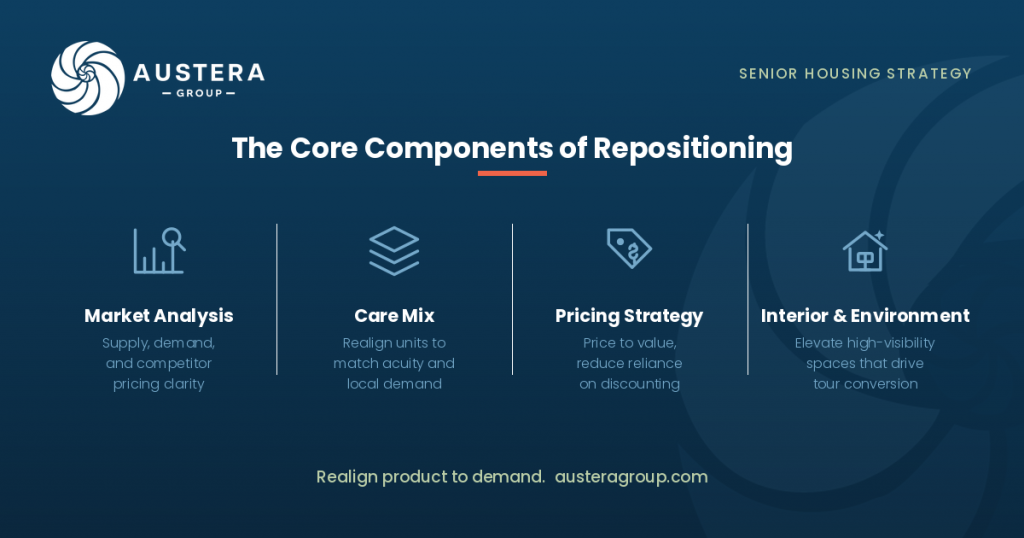
There is no single template, because every community’s situation is different. But most well-executed repositioning efforts include the same core layers.
Market analysis first. Not a competitive tour, not a demographic pull, but honest analysis of what the local market actually needs and how the community stacks up against it. In a recent assessment we completed for a large rental CCRC in the Midwest, this step surfaced that the community’s active adult offering was priced roughly 37 percent below its market rate, which was creating a perception in the local market that the whole community was low-income housing. That kind of finding shapes every other decision that follows.
Care mix realignment. Sometimes the most consequential decision in a repositioning is how the units are allocated across care levels. At Monarch at Cedar Park, an underperforming 60-unit stand-alone memory care community that never exceeded 68 percent occupancy, the repositioning converted the community into 27 units of memory care and 30 high-acuity assisted living suites. The building didn’t change size. The service the market actually needed did.
Pricing that matches the delivered experience. Pricing is not a math problem, it is a positioning statement. If a family walks in expecting one experience because of the rate and encounters something that doesn’t match, no marketing spend will save the tour. Repositioning almost always includes a hard look at whether the rate structure aligns with what the community actually delivers.
Physical environment. Design in senior housing is part of positioning, not decoration. Common areas, dining spaces, memory care neighborhoods, and the entry sequence all communicate the value proposition before the sales team says a word. But the environmental work should follow the strategy, not lead it.
Language and hospitality vocabulary. This is the piece most operators underestimate. The words a community uses in its signage, its titles, its marketing, and its sales conversations shape how prospects and families feel about the place. Words like room, admissions, discharges, and facility are clinical. Words like apartment, welcome, community, and neighborhood are hospitality. In our practice, changing the language is often one of the fastest, cheapest, and most under-utilized levers in a repositioning.
Sales and marketing alignment. Everyone on the team needs to be able to articulate what has changed, why it matters, and who the community now serves best. Repositioning fails when the market has been told nothing has shifted, because from the outside, nothing has.
Preserve What Works. Replace What Doesn't.
One of the most persistent misconceptions about repositioning is that it requires a full replacement of everything. In practice, the opposite is often true. Disciplined repositioning means knowing what not to replace.
At Alamar Senior Living, our team repurposed approximately fifty percent of existing furniture and furnishings, refinishing and reupholstering where possible and integrating them alongside new pieces where the aesthetic vision called for something different. The community achieved a fully refreshed, hospitality-driven look while maximizing return on investment. At Monarch, the existing backsplash and countertops in the memory care servery were preserved and the space was repainted. A cost-effective solution that added real value to ownership without unnecessary replacement.
Strategic reuse requires design expertise and market awareness. It is not about cutting corners. It is about directing capital toward the areas that most influence occupancy and perceived value.
The Financial Reality
Repositioning is a capital decision, and it should be underwritten like one. Well-executed repositioning can lift average monthly rent, improve care revenue mix, reduce discounting, strengthen NOI, and materially improve long-term valuation. But the payback horizon is typically two years or more, and the physical investment is often the smaller part of the total cost. The larger part is the operational discipline required to hold the plan through the eighteen to twenty-four months before the market’s perception of the community fully catches up.
Owners who go in expecting fast results tend to lose confidence at the twelve-month mark, right before the trajectory starts to bend. That is one of the most common ways I have seen a good repositioning get abandoned before it delivers.
When to Bring in Outside Help
Repositioning involves too many interlocking pieces for most internal teams to lead alone. Market analysis, care mix decisions, pricing strategy, environment, language, sales alignment. These require different disciplines, and they need to be coordinated. Outside advisory support helps in three specific ways. It provides an objective read on the market. It forces the discipline of connecting the strategy to the capital plan. And it keeps the team focused when the middle of the engagement gets hard.
Bringing in outside eyes is not a signal that the internal team has failed. It is a commitment to the outcome.
Where to Go From Here
Senior housing repositioning done well changes the trajectory of an asset. Done poorly, it depletes capital without moving the census. The difference is almost always in the strategic clarity of the plan before the first dollar is deployed.
If your community’s performance is stalled and you are trying to figure out whether repositioning is the right conversation, that is usually the moment when outside perspective helps most.
Ready to Talk?
If you are weighing a repositioning, working through a turnaround, or trying to figure out whether the trajectory of your community can shift without a full-scale renovation, we can help you see the situation clearly and identify where to focus first. Book a discovery conversation with our team.